Rockfin Unveils Its First Hydrogen Generator: HyVentive
Blog
10.07.2025

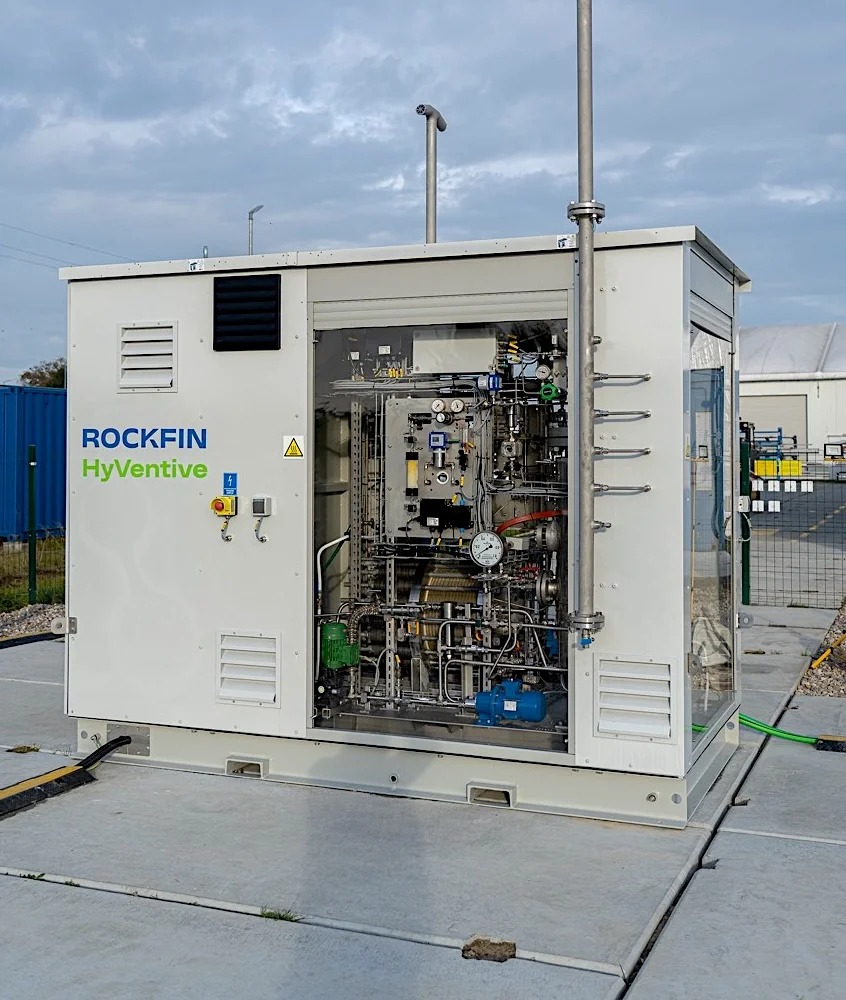
Rockfin S.A., headquartered in Małkowo near Gdańsk, has successfully designed, built, and commissioned its first Hydrogen Generator named HyVentive. This innovative project represents the culmination of work by the company’s Research and Development team, which initiated the concept in 2021. The vision was to create a green energy solution that aligns with national and global objectives for decarbonisation and sustainable development.
In 2022, the engineering team began detailed design work, developing advanced technical specifications to ensure the generator would be not only efficient but also safe and compliant with the highest international standards.
By 2023, the focus shifted to production, assembly, and integration of the generator’s key components. Finally, in 2024 the HyVentive generator was launched, marking a significant milestone in Rockfin journey toward clean energy innovation. The system is currently undergoing rigorous testing to validate its operational parameters and ensure full compliance with its design specifications.
The indicative cost of commercially available hydrogen generators currently stands at approximately € 2 million per megawatt (MW) of installed capacity. However, the total cost is influenced by the generator’s target capacity: larger systems generally benefit from economies of scale, reducing the per MW cost.
It is essential to consider the broader infrastructure required for hydrogen production. Beyond the generator itself, a complete system necessitates auxiliary components such as compression, storage, and distribution facilities. Consequently, the total cost of such an installation can be two to three times higher than the generator’s base cost.
The HyVentive demonstration unit in Małkowo, with a capacity of 10 kW, is designed as a prototype to evaluate functionalities and parameters equivalent to larger commercial systems, such as a 1 MW installation. With a daily production capacity of several kilograms of hydrogen, this demonstrator offers significant insights into scalability. For perspective, 1 kg of hydrogen powers a Toyota Mirai passenger car for 100 km, while a Solaris Urbino 12 Hydrogen city bus consumes approximately 6.5 kg for the same distance.
The hydrogen produced by the HyVentive demonstrator is currently reserved for research and development purposes. Once internal testing is complete, the system may be made available to external stakeholders interested in exploring hydrogen applications in transport, industry, and energy storage.
While the HyVentive generator is a regional milestone, other hydrogen installations are operational across Poland. For instance, a 5 MW electrolyzer in Gaj Oławski, near Wrocław, utilises renewable energy from a wind and photovoltaic hybrid system to produce up to 1.2 tonnes of hydrogen per day
Additionally, the Orlen Group operates a research-focused hydrogen unit at its Jasło refinery. Unlike the HyVentive system, which relies on water electrolysis, this facility uses process steam for hydrogen production, achieving a daily output of 18 kg. These projects highlight Poland’s growing interest in hydrogen technologies and its commitment to sustainable energy solutions. In addition, large scale installations are also being designed and the first tenders are being launched.
Rockfin is committed to advancing hydrogen technologies with its HyVentive systems line, which includes scalable solutions ranging from 0.5 MW to 5 MW capacities. These systems are designed to meet the growing demand for green energy in industrial processes, transportation, and grid stabilisation.
A key advantage of HyVentive systems portfolio is their adaptation to individual needs. Rockfin offers flexible solutions that can be tailored to the requirements of customer’s application. The company places great emphasis on the development of enabling technologies that increase the efficiency and safety of hydrogen installations.
Currently, Rockfin is working on a number of auxiliary systems of its own design, such as: detection systems, post-purification systems or hydrogen compression and storage installations. In terms of refueling cars and buses, additional cleaning is an important element, as a very high fuel purity of 99.999% is required.
The hydrogen sector in Poland, particularly in Pomerania, is poised for substantial growth as part of the broader energy transition. Hydrogen is seen as a cornerstone for achieving net-zero emissions and decarbonising the economy, and Poland, thanks to its resources and growing involvement in renewable energy projects, has a chance to become an important player in this field.
Pomerania, with its robust industrial base and strategic access to maritime infrastructure, holds a pivotal role in advancing the hydrogen economy. The region is particularly well positioned to leverage renewable energy from offshore wind farms in the Baltic Sea, making it an ideal hub for green hydrogen production. Among the most promising initiatives are projects integrating wind energy with hydrogen generation to support decarbonisation efforts across various sectors.
The presence of numerous companies within the Hydrogen Technology Cluster further underscores Pomerania’s potential. These enterprises are actively engaged in the development of innovative hydrogen technologies, encompassing electrolyzer systems, compression solutions, and storage infrastructure. Such collaborations are vital for fostering a thriving hydrogen ecosystem and accelerating the transition to sustainable energy solutions.
Poland, as a whole, stands at a critical juncture to attract significant investment in the hydrogen industry. Government incentives, European Union funding, and increasing private sector engagement present substantial opportunities to scale hydrogen projects. However, the industry faces key challenges, particularly the need for further infrastructure development and the optimised integration of renewable energy resources. Addressing these barriers will be essential to enable the large-scale production, storage, and distribution of green hydrogen, ensuring its role as a cornerstone in the country’s energy transition.