
Hydrogen Refueling Station
Modern HRS (Hydrogen Refueling Station) solutions by Rockfin HyVentive help build infrastructure for zero-emission heavy-duty and fleet transport.
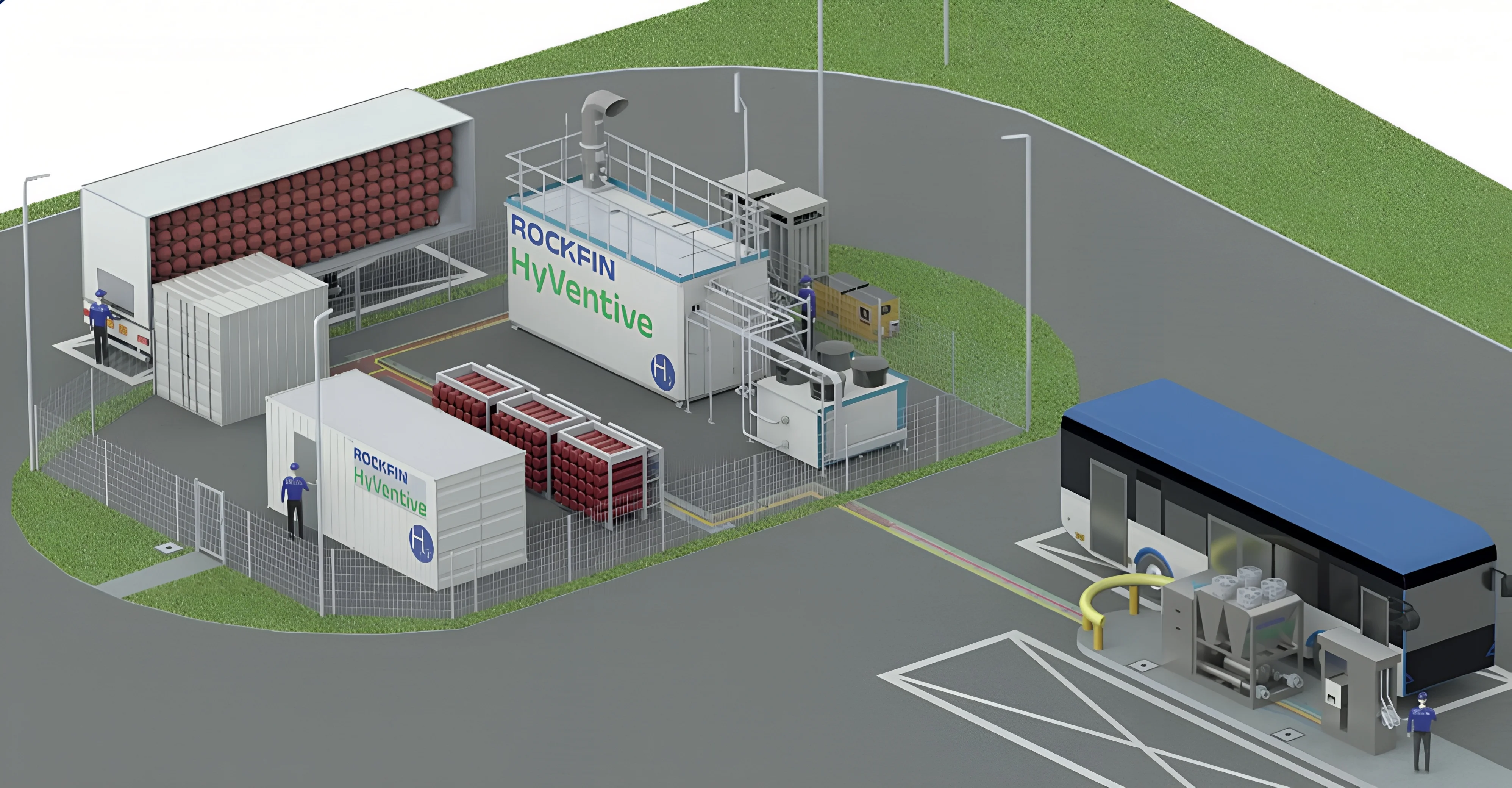
HRS Stations – Hydrogen Fuel for a New Era of Mobility
Modern HRS (Hydrogen Refueling Station) solutions by Rockfin HyVentive help build infrastructure for zero-emission heavy-duty and fleet transport. They enable fast and safe hydrogen refueling for passenger cars and heavy-duty vehicles, in a significantly shorter time than recharging electric vehicles.
Designed and manufactured in Poland, based on Rockfin's proprietary technologies, they offer high reliability with optimized operating costs while meeting European standards. It is infrastructure designed not only to meet current market needs, but also to support its dynamic growth in the years to come.
Construction and operating principle of an HRS station
The HRS station is used for refueling hydrogen-powered vehicles equipped with fuel cells. Its architecture has been designed to allow flexible adaptation to the hydrogen supply model and the scale of the investment.
Hydrogen can be supplied to the station from two independent sources:
- directly from a trailer,
- from a local hydrogen generator (e.g., the R-GEN series from the HyVentive line).
Depending on the hydrogen source and the current installation parameters of the system, the station can operate in different operational configurations.
Supply from a trailer:
If the appropriate refueling pressure parameters are met, a cascade (pressure-differential) refueling method is used, in which hydrogen flows from the trailer into the vehicle tanks due to the difference in pressure. This process does not require the use of a compressor, which allows for:
- reduced refueling time,
- lower energy consumption,
- minimized compressor operation,
- reduced maintenance costs.
When the hydrogen pressure in the trailer drops below the level required for cascade (pressure-differential) refueling, the system automatically directs the gas to a compressor, where its pressure is increased to the required operating level. The hydrogen is then transferred to high-pressure storage, from which vehicles are refueled again in a stable and controlled manner.
This architecture increases the energy efficiency of the installation and enables optimization of operating costs throughout the entire lifecycle of the station.
Supply from a hydrogen generator:
An alternative solution is to integrate the HRS station with a local hydrogen generator, e.g., an R-GEN series generator from the HyVentive line. In this configuration, the installation is equipped with buffer, stabilizing the system's operation and ensuring continuous hydrogen supply.
The hydrogen stored in the buffer tanks is then directed to a compressor, where it reaches the required operating pressure. After compression, the gas is delivered to high‑pressure storage tanks, from which the vehicles are refueled using the transfer method.
This solution allows for independent and continuous operation of the station, without the need for fuel deliveries, while maintaining full control over hydrogen quality and quantity.
A complete HRS station consists of the following components:
- hydrogen unloading and distribution panel,
- hydrogen compression station,
- hydrogen storage,
- cooling system,
- refueling dispensers,
- control and power supply system.
The performance of the entire system depends mainly on the compressor power, hydrogen storage capacity, and the number of dispensers.
Scope of HRS Station Supply
Basic Equipment
- Unload panel
- High‑pressure tube trailer overflow filling bypass
- R-COM series compressors
- Distribution panel
- Single dispenser – 350 bar or 700 bar
- Cooling system
- Safety system
- Control system
- Nitrogen purging system
Additional Equipment
- Dual‑pressure dispenser – 350 bar or 700 bar
- Hydrogen control system
- R-GEN series hydrogen generator
Services and Maintenance
- Transportation and unloading at the installation site
- Additional preservation during storage period
- Execution of interconnections between system components
- Connection of the system to utilities
- Participation in commissioning
- Personnel training
- Periodic inspections and maintenance services
Key Advantages of HRS Stations
Modularity:
HRS stations are a modular solution, allowing gradual expansion of infrastructure as hydrogen demand grows. The system architecture enables:
- adjustment of refueling pressure for different types of vehicles,
- increased station throughput - more vehicles refueled per day,
- integration with a hydrogen generator - ensuring continuous and independent station operation.
Turnkey implementation:
Rockfin offers a solution, covering engineering design, equipment production, delivery, installation, commissioning and service support.
This model minimizes the investor's involvement in coordination, ensuring that the client receives a fully functional system ready for immediate operation.
Highest quality standards:
By using its own HyVentive series hydrogen equipment -including R-COM compressors and R-GEN generators - Rockfin ensures full control over the quality and technical parameters of the entire system.
Our stations are designed with high reliability, user safety, and low operating costs in mind.
Compliance with EU Directives and Industry Standards
HRS refueling stations carry the CE mark and are designed in accordance with the following European Union directives and international industry standards:
- MD 2006/42/EC - Machinery Directive,
- PED 2014/68/EU – Pressure Equipment Directive,
- EN 61508 - Functional safety of electrical/electronic/programmable electronic safety-related systems
- EN 61511 - Functional safety – Safety instrumented systems for the process industry sector,
- EN 12100 – Safety of machinery – General principles for design – Risk assessment and risk reduction
- EN 60204-1 - Safety of machinery – Electrical equipment of machines
- EN 1127-1 - Explosive atmospheres – Explosion prevention and protection
- EN 60079 – Series of standards for electrical equipment used in explosive atmospheres
- EN 1090 - Execution of steel and aluminium structures
- EN 764-7 - Pressure equipment – Safety systems for unfired pressure equipment
- EN 13445- Unfired pressure vessels
- ASME BPVC VIII –ASME rules for the construction of pressure vessels
- ISO 22734 – Hydrogen generators using water electrolysis
- ASME B31.12 – Hydrogen piping and pipelines,
- EIGA DOC 15 – Hydrogen installations
- EIGA DOC 211 – Hydrogen vent systems for commercial applications,
- EIGA Doc 121 – Hydrogen pipelines,
- ISO 14687 – Hydrogen fuel quality
Example HRS station configurations
Station 350 bar
- Refueling Pressure: 350 bar
- Refueling Time: 30 min
- Number of Dispensers: 1
- Hydrogen Storage: 500 bar
- Typical Application: Fleets of several to a dozen buses or municipal vehicles
Station 700 bar
- Refueling Pressure: 700 bar
- Refueling Time: 5 min
- Number of Dispensers: 1
- Hydrogen Storage: 900 bar
- Typical Application: Passenger vehicle fleets, e.g. taxi services
Station 350/700 bar
- Refueling Pressure: 350 bar / 700 bar
- Refueling Time: 20 min / 5 min
- Number of Dispensers: 2-3
- Hydrogen Storage: 500 bar / 900 bar
- Typical Application: Commercial stations in city centers or near transport hubs